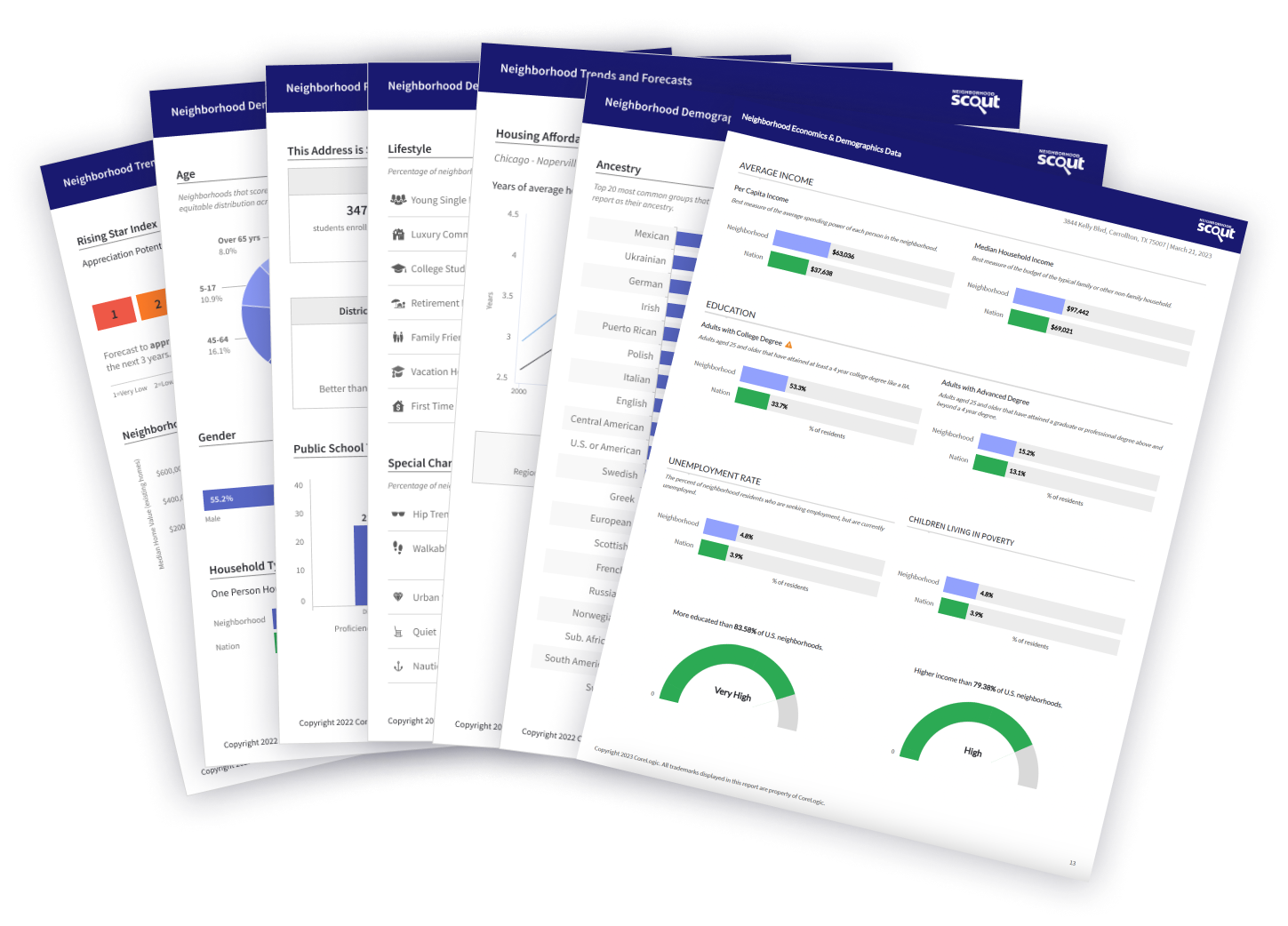
What do we mean by a neighborhood?
NeighborhoodScout® uses the official government designation for neighborhoods - the census tract.
Census tracts are small, relatively permanent subdivisions of a county that are defined by the U.S. Census Bureau in conjunction with local authorities all across the country to define real neighborhoods that are bounded to contain areas with homogeneous population characteristics (including economic status, lifestyle, and living conditions). Census tracts usually have 4,000 persons, but can range between 1,500 and 8,000 persons. This is the most fine-grained area for which detailed information is made available from the government, to protect the individual privacy of each of us. Because census tracts are based on population, they vary in size depending on the density of settlement. In urban areas, they are small, and in rural areas they can cover an entire small town or even a few small towns in very rural areas.
Since census tracts are subdivisions of a county, we did a spatial overlay of the census tracts onto city and town boundaries using a geographic information system to properly assign each census tract to its appropriate city or town. Then we named each census tract to the local colloquially recognized neighborhood name for that spot (e.g., Boston, MA (Dorchester). If there was not a name available, we named the census tract by the largest street intersection in the census tract (e.g., Worcester, MA (Lincoln St/Plantation St)
Why we don't use Zip Codes as neighborhoods
Zip codes were developed by the Postal Service for the purpose of delivering mail, but were never intended to define coherent neighborhoods. In addition, Zip Codes can have as many as 10 distinctly different census tracts contained within them. When distinct census tracts are blended together in a single Zip Code, the data reflects their average conditions and often gives a false sense of the area. The result is that potentially great matching neighborhoods can be missed, and erroneous matches can also be produced and delivered to you.
Using census tracts makes great matches possible, and helps people find the areas that are best for them and their families. Because we are committed to providing the highest possible quality and finding the neighborhoods that best meet your criteria, we use census tracts. And, as always, we show you the actual street map of the neighborhood so you know exactly where your best matching neighborhood is located.
What is a Condition Alert?
A condition alert is a condition in the neighborhood that triggers an alert. NeighborhoodScout contains condition alerts to highlight conditions that are extreme, whether good or bad. This helps answer crucial questions about the state of the neighborhood being evaluated, such as:
What are the risks of violent crime here?
Is the risk of home break-ins or other property crimes increasing?
Does real estate here hold its value?
Are the trends in local vacancies or unemployment concerning?
...and dozens more.
Information at a glance that you need to know to invest, appraise or finance a property.
Salt Lakes Foster Village Northeast median real estate price is $964,693, which is more expensive than 50.0% of the neighborhoods in Hawaii and 89.5% of the neighborhoods in the U.S.
The average rental price in Salt Lakes Foster Village Northeast is currently $5,883, based on NeighborhoodScout's exclusive analysis. The average rental cost in this neighborhood is higher than 96.1% of the neighborhoods in Hawaii.
Salt Lakes Foster Village Northeast is a suburban neighborhood (based on population density) located in Honolulu, Hawaii.
Salt Lakes Foster Village Northeast real estate is primarily made up of medium sized (three or four bedroom) to large (four, five or more bedroom) townhomes and single-family homes. Most of the residential real estate is renter occupied. Many of the residences in the Salt Lakes Foster Village Northeast neighborhood are newer, built in 2000 or more recently. A number of residences were also built between 1970 and 1999.
In Salt Lakes Foster Village Northeast, the current vacancy rate is 2.6%, which is a lower rate of vacancies than 81.4% of all neighborhoods in the U.S. This means that the housing supply in Salt Lakes Foster Village Northeast is very tight compared to the demand for property here.
Notable & Unique Neighborhood Characteristics
When you see a neighborhood for the first time, the most important thing is often the way it looks, like its homes and its setting. Some places look the same, but they only reveal their true character after living in them for a while because they contain a unique mix of occupational or cultural groups. This neighborhood is very unique in some important ways, according to NeighborhoodScout's exclusive exploration and analysis.
Occupations
With 40.0% of employed workers living in the Salt Lakes Foster Village Northeast neighborhood active in the military, this neighborhood has the distinction of having a higher proportion of people in the military than 99.9% of American neighborhoods. This is a major shaper of the neighborhood's culture and character.
Real Estate
Many people dream of living along a street lined with row houses or other attached homes. Such places do often have an abundance of charm. If you are one of these people, the Salt Lakes Foster Village Northeast neighborhood could be your paradise. With 69.4% of the homes and real estate here classified as rowhouses or other attached homes, this neighborhood brims with opportunity to find the right place for you. Only 0.4% of U.S. neighborhoods have more row houses than this neighborhood, making it one of the most interesting things about this special neighborhood.
In addition, 95.8% of the real estate in the Salt Lakes Foster Village Northeast neighborhood is occupied by renters, which is nearly the highest rate of renter occupancy of any neighborhood in America.
Furthermore, if you like the look and ambience of new homes and newly built neighborhoods, you will love the Salt Lakes Foster Village Northeast neighborhood. A whopping 85.3% of the homes and other residential real estate here were built after 1999, which is a higher proportion of new homes then you will find in 98.0% of the neighborhoods in the U.S. Everything here just feels new. In fact, the concentration of newer homes here is so great that they completely dominate the landscape. In most neighborhoods, there is a mixture of ages of residential real estate, but here it is almost completely built during one time frame: 2000 through today.
Also of note, one way that the Salt Lakes Foster Village Northeast neighborhood really stands out, is that it has more large 4, 5, or additional bedroom homes and real estate than 97.6% of the neighborhoods in America. When you walk or drive around this neighborhood, you'll instantly notice the size of the homes here which definitely makes a strong visual statement.
People
Astoundingly, NeighborhoodScout's research reveals that this single neighborhood has a higher concentration of married couples living here than 96.5% of all U.S. neighborhoods. Whether they have school-aged children or not, married couples are the rule in the Salt Lakes Foster Village Northeast neighborhood. If you are a married couple, you may find many people here with a similar lifestyle, and perhaps common interests. But if you are single, you might not find many other singles here.
Diversity
Did you know that the Salt Lakes Foster Village Northeast neighborhood has more Eastern European ancestry people living in it than nearly any neighborhood in America? It's true! In fact, 4.7% of this neighborhood's residents have Eastern European ancestry.
Migration / Stability
Do you like to be surrounded by people from all over the country or world, with different perspectives and life experiences? Or do you instead prefer to be in a neighborhood where most residents have lived there for a long time, creating a sense of cohesiveness? NeighborhoodScout's analysis reveals that this neighborhood stands out among American neighborhoods for the uniqueness of the mobility of its residents. In the Salt Lakes Foster Village Northeast neighborhood, a greater proportion of the residents living here today did not live here five years ago than is found in 99.0% of U.S. Neighborhoods. This neighborhood, more than almost any other in America, has new residents from other areas.
The Neighbors
There are two complementary measures for understanding the income of a neighborhood's residents: the average and the extremes. While a neighborhood may be relatively wealthy overall, it is equally important to understand the rate of people - particularly children - who are living at or below the federal poverty line, which is extremely low income. Some neighborhoods with a lower average income may actually have a lower childhood poverty rate than another with a higher average income, and this helps us understand the conditions and character of a neighborhood.
The neighbors in the Salt Lakes Foster Village Northeast neighborhood in Honolulu are middle-income, making it a moderate income neighborhood. NeighborhoodScout's exclusive analysis reveals that this neighborhood has a higher income than 49.8% of the neighborhoods in America. With 19.2% of the children here below the federal poverty line, this neighborhood has a higher rate of childhood poverty than 68.3% of U.S. neighborhoods.
What we choose to do for a living reflects who we are. Each neighborhood has a different mix of occupations represented, and together these tell you about the neighborhood and help you understand if this neighborhood may fit your lifestyle.
In the Salt Lakes Foster Village Northeast neighborhood, 40.0% of the working population is employed in the military. The second most important occupational group in this neighborhood is executive, management, and professional occupations, with 37.2% of the residents employed. Other residents here are employed in sales and service jobs, from major sales accounts, to working in fast food restaurants (29.8%), and 24.4% in manufacturing and laborer occupations.
Languages
The most common language spoken in the Salt Lakes Foster Village Northeast neighborhood is English, spoken by 84.4% of households. Some people also speak Spanish (6.7%).
Ethnicity / Ancestry
Boston's Beacon Hill blue-blood streets, Brooklyn's Orthodox Jewish enclaves, Los Angeles' Persian neighborhoods. Each has its own culture derived primarily from the ancestries and culture of the residents who call these neighborhoods home. Likewise, each neighborhood in America has its own culture – some more unique than others – based on lifestyle, occupations, the types of households – and importantly – on the ethnicities and ancestries of the people who live in the neighborhood. Understanding where people came from, who their grandparents or great-grandparents were, can help you understand how a neighborhood is today.
In the Salt Lakes Foster Village Northeast neighborhood in Honolulu, HI, residents most commonly identify their ethnicity or ancestry as Mexican (18.1%). There are also a number of people of English ancestry (9.2%), and residents who report German roots (6.4%), and some of the residents are also of Irish ancestry (4.7%), along with some Eastern European ancestry residents (4.7%), among others.
Getting to Work
How you get to work – car, bus, train or other means – and how much of your day it takes to do so is a large quality of life and financial issue. Especially with gasoline prices rising and expected to continue doing so, the length and means of one's commute can be a financial burden. Some neighborhoods are physically located so that many residents have to drive in their own car, others are set up so many walk to work, or can take a train, bus, or bike. The greatest number of commuters in Salt Lakes Foster Village Northeast neighborhood spend between 15 and 30 minutes commuting one-way to work (48.3% of working residents), which is shorter than the time spent commuting to work for most Americans.
Here most residents (84.8%) drive alone in a private automobile to get to work. In addition, quite a number also carpool with coworkers, friends, or neighbors to get to work (6.1%) . In a neighborhood like this, as in most of the nation, many residents find owning a car useful for getting to work.
SCOUT’s patented match algorithm identifies the most similar neighborhoods to a subject location, and quantifies the similarity to the subject location. This allows analysts to identify the most similar neighborhoods in a local market area for appraisals, investments, and research.
The algorithm uses 273 neighborhood conditions, identifies the dominant dimensions underlying the conditions and calculates the similarity. This captures the true culture and character of locations, economic conditions, and trends.
The closer to 100% means the locations are nearly identical. 80% is a very good, but not excellent match, and so forth.